The Machine Who is a series of executable code poems. An executable code poem is a in its essence a program, written in the programming language PHP, but of which the source code can be read by non-programmers as a poem. However, the code can still be executed, using a PHP interpreter (available on almost every modern computer) to experience another dimension of the poem. The effect of the execution can be a randomnization of some sort, a decryption, or an infinite loop, but always bears a connection to the theme of the poem, which is always related to programming and its role in modern society.
This project is an attempt at subverting long-standing automation paradigms and suggests a new de-mystified way of looking at computer code. Nick Montfort et al proposes that “code is a social text, the meaning of which develops and transforms as additional readers encounter it over time and as contexts change.” (Montfort et al, 2013) and Mark Marino adds that we “must read code for more than what it does—we must consider what it means.” (Marino, 2020.)
For a writer and coder, like me, code poems are the point of contact between literature and computer code. But where literature is associated with artistry, freedom, and progressive thinking, code is more often classified in terms of mystification, occlusion, and impenetrable mathematical complexity. This image is carefully cultivated by the software industry or the tech-industrial complex it has grown into. This industry has transformed from an alternative
Behind the opaqueness of computer code often hide methods of systemic exclusion, political influence, and other ways to perpetuate the inequality in our societies. While code is an abstract concept to many of us, its consequences are very real for an ever growing number of people.
Changing the context of the code to the realm of poetry, is an attempt to strip it of its mathematical mystique, and break through its intentional barriers, cultivated by the software industry. In the process of this re-contextualization the code is ‘disarmed’ and turned into a ‘toothless monster’– something that serves at the pleasure of the audience; a dancing bear in a circus instead of a highly efficient weapon.
Randomize Me, for example, takes the process of randomization as its focal point. As a fundamental concept in computation, it serves as something simultaneously inseparable from automation processes, and as a symbol for its ruthless pragmatism, of its apolitical indeterminism, and of its all-engulfing late-capitalist efficiency.
By treating code as a text, it becomes an end-product rather than a means-to-an-end. The code is forced into the visible world, whereas it typically remains hidden, doing its work out of sight in abstract spaces. This confrontation reminds us of code’s many real-world consequences. By bringing it “out of the dark and into the light,” I hope to expose it and make it “show its ugly face.” At the same time, displaying the code turns the poem into an encounter with unfamiliar syntax for those who don’t regularly work with it. As Chun notices, “reading code requires a new set of methods.” This means that the vast majority of the population is excluded, and this is by design as the tech-industrial complex thrives on the idea of code as an impenetrable fortress (Chun, 2011). The exposition to code in this format could serve as a first step toward creating a population more resilient against an industry that tries to mislead them.
References
Chun, Wendy. (2011). Programmed Visions: Software and Memory. 9780262015424.001.0001. MIT Press.
Marino, Mark C. ; 2020. Critical Code Studies. 9780262043656. MIT Press.
Montfort, Nick, Patsy Baudoin, John Bell, Ian Bogost, Jeremy Douglass, Mark C. Marino, Michael Mateas, Casey Reas, Mark Sample, and Noah Vawter. 2013. 10 PRINT CHR$(205.5+RND(1)); : GOTO 10 (Software Studies). MIT Press.
- Read my first code poem “Infinite Loop” published in 2022 by Volume Poetry.
- Read my second code poem “WHAT_IS_LOST” published in 2023 by Volume Poetry.
- Read my UML poem “A Bit of Surveillance” published in 2025 by Reality Scratch.
-

ELO Conference 2026
Looking forward to the ELO Conference 2026: (Un)supervised @ UCF! From the website: “This year’s event will continue ELO’s tradition of bringing together scholars, artists, and practitioners of electronic literature from around the world.” Monica Storss and I will present the workshop “Out Of This World: An Exoplanetary Workshop”! Can’t wait!
-

Poem: A Bit of Surveillance
Berlin’s most sympathetic journal, Reality Scratch, published my UML poem “A Bit of Surveillance”. Thanks to editors Melissa Frost and Thomas McDonald and all the other authors for this great issue! This poem was constructed using UML (Unified Modeling Language), a modeling tool for software systems. To create the diagram and try and capture the current precarious moment in tech affairs, I used PlantText (the expert’s design…
-
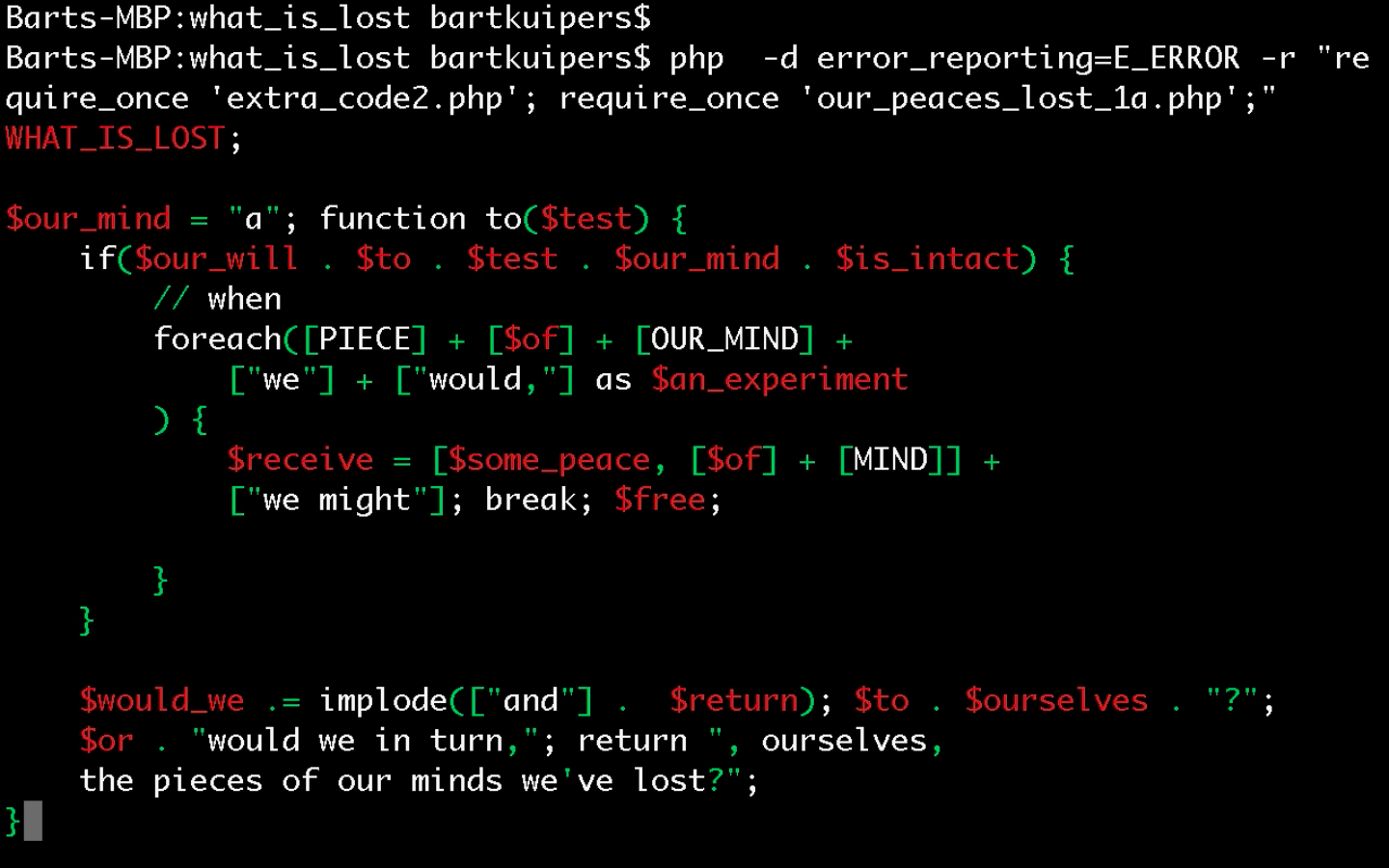
WHAT_IS_LOST
My poem WHAT_IS_LOST was published by Volume Poetry! “What is Lost” is an executable code poem: a poem written in code, readable for non programmers, but executable on the command line of any Linux or Mac OSX computer. The poem reflects on how human minds have been transformed into sources of data collection and have…
-
infinite_loop
My code poem infinite_loop was published by Volume Poetry Read it here, and check out the latest edition of Volume, volume 3 issue 1!